
Guilderland City Directory Collections Guide
Guilderland research draws from several collections, not one uniform town run. The Albany Public Library, or APL, holds an almost complete Albany city sequence beginning in 1813 and some suburban volumes. Schenectady County Public Library, or SCPL, is the strongest named source for Guilderland-area suburban books. Albany County Hall of Records adds city directories, street guides, and a business directory that can connect an Albany address to a later town address. Start by matching the year and the volume's geographic title to the person or address in question.
| Collection | Years | Where Held | Access |
|---|---|---|---|
| Albany city directory run | 1813-present | APL Local History Room | Reference collection, appointment required |
| Colonie/Bethlehem/Guilderland volumes | 1956-1978 | SCPL city-directory holdings | Confirm current onsite availability |
| Albany Suburban directories | 1916, 1926, 1936 | New York State Library | Microfilm catalog holdings |
| Albany directories and street guides | 1830-1994; guides 1914-present | Albany County Hall of Records | Onsite or staff-assisted research |
An Albany title can be useful without being a complete Guilderland list. The APL guide says the city run is nearly complete, while Guilderland coverage varies by individual suburban volume. Hall holdings are specifically Albany city material. Read the title page, the suburb or street sections, and the publication date before treating a missing name as meaningful.
Note: Record the exact title, edition year, page, and geographic scope before comparing a Guilderland directory entry with another source.
Guilderland City Directory Scope
Older Guilderland records often use a hamlet, village, farm, road, lot, or nearby postal place rather than a modern street-number format. The town includes the Village of Altamont and a mix of rural, suburban, and border-area places. A surname may therefore appear in an Albany city volume, an Albany suburban title, a Colonie/Bethlehem/Guilderland book, or not appear because the publisher did not cover that address that year.
Scope is a research fact, not a nuisance to skip. Search notes should retain the printed place name, a modern road spelling, and possible postal labels such as Altamont, Guilderland Center, Albany, or Schenectady. A title that reaches one suburb need not reach every town road. The directory can still supply an occupation, business, spouse hint, or old address worth testing against a deed, census record, or newspaper.
Guilderland Directory Gaps
The APL chronology gives the directory shelf useful landmarks as well as limitations. The Albany sequence begins in 1813 and changes publishers many times, eventually moving from R. L. Polk to later Polk and Equifax Polk titles. Its microfilm and printed holdings are not an unbroken substitute for every year or every Guilderland household. Keeping a small gap log prevents a search from turning an unavailable edition into a claim that someone was absent.
- 1813: the documented Albany city run begins.
- 1836: no directory is listed in the APL chronology.
- 1872: the Street Directory first appears.
- 1895/1896 and 1914: the House Directory appears, later resumes, and adds cross streets.
- 1932 and 1967: the House Directory merges into the Street Directory, and later editions begin listing ZIP codes.
APL also lists 1980 as absent and says 1982, 1984, and 1987 were not published. Those are publication or holding gaps, not evidence that a family left Guilderland. Move to the nearest available edition, then compare a census, an annual assessment roll, a deed, or a dated newspaper item. The later Street & Avenue Guide can also help reconcile an old road reference with cross streets, wards, or ZIP information.
Guilderland Suburban Directory Volumes
SCPL's city-directory holdings table identifies Colonie/Bethlehem/Guilderland volumes for 1956 through 1978, a particularly useful run for Guilderland household research.
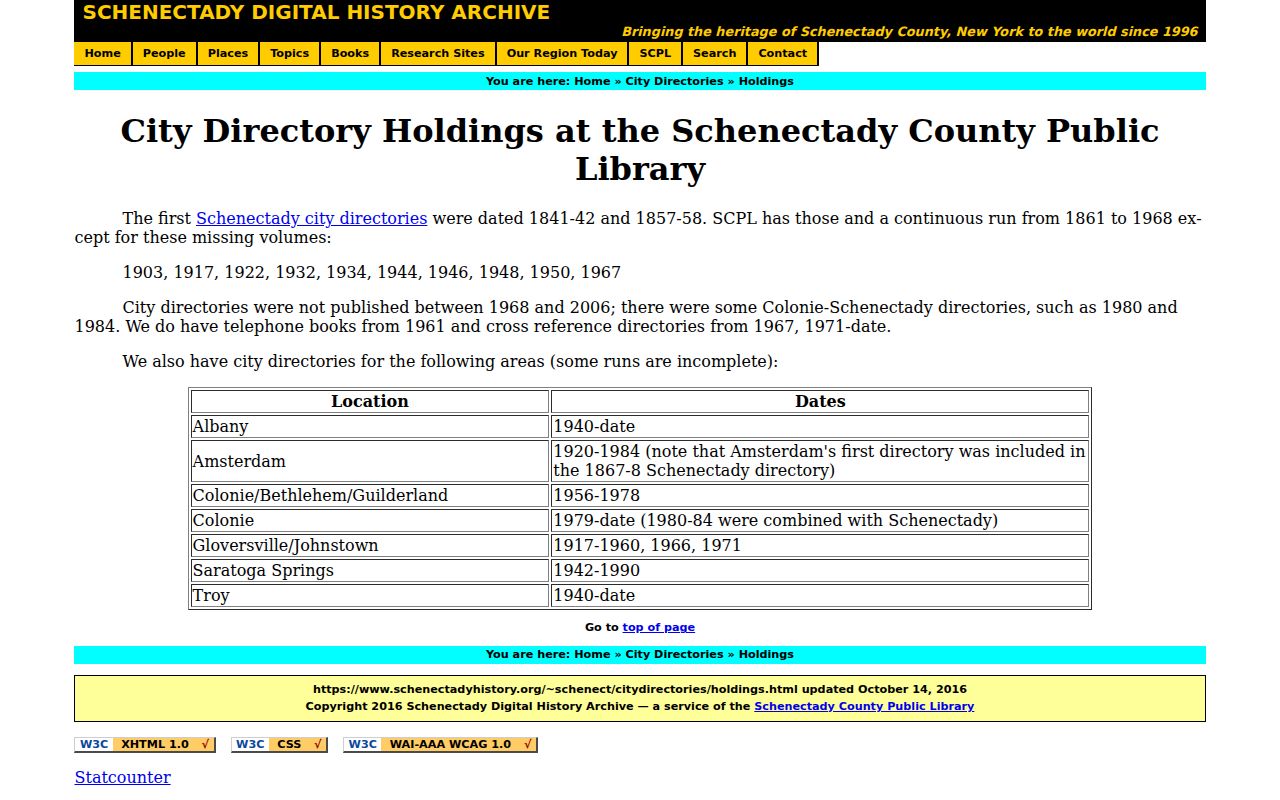
The holdings table was updated in 2016, so confirm that a volume is still available before traveling. Its value is geographic: it names a Guilderland-inclusive series rather than requiring a researcher to guess whether an Albany city edition reaches a town address. The New York State Library city-directory catalog supplies another route, with Albany Suburban films for 1916, 1926, and 1936. Inspect the title page and the street section because the catalog does not define each suburban boundary.
Reading Guilderland City Directory Entries
A directory entry is compact, so read it as a transcription of what the publisher chose to print in that edition. The alphabetic section commonly gives a surname, given name or initials, an occupation and sometimes an employer, then a residence or boarding address. A spouse or widow notation can separate two similarly named people. Street and business sections may add cross references, ward detail, cross streets, or, in later books, a ZIP code.
The digitized 1914 Albany City Directory shows the alphabetic name, address, and occupation style used in a historical city-directory scan.
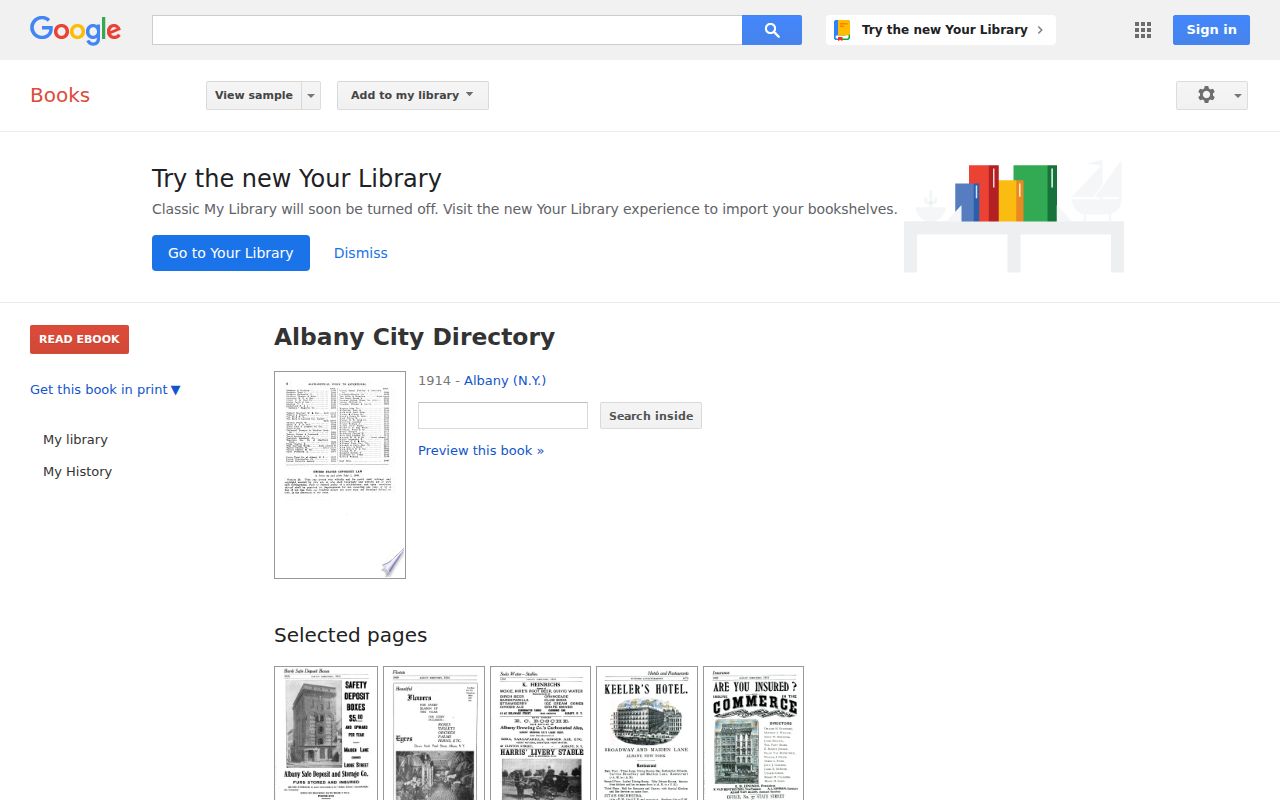
Photograph or transcribe the entry together with its edition and page. The abbreviation key is at the beginning of the volume, and it changes how a short entry should be read. The guide identifies h as a home or residence marker and bds as boarding. Starting after 1881, some directories also place death dates after former residents, often through about 1960. That is a lead for an obituary or probate search, not a stand-alone death record.
| Name | Surname plus printed given name or initials, useful for variant-name checks. |
|---|---|
| Occupation | Work description and, where supplied, employer or business location. |
| Residence | Home address, often marked h, or a boarding address marked bds. |
| Household clue | Spouse, widow, boarder, or former-resident notation when the edition includes it. |
| Street reference | Pointer to a street, house, or business section with location context. |
- Criss-cross directory
- A reverse directory arranged by address or street so a researcher can move from a location to listed names.
- Householder index
- An index focused on the named household at an address, rather than every person who may have lived there.
- Abbreviation key
- The volume's front-matter guide to short forms such as residence and boarding marks; save it with the entry.
Guilderland Street Directory Milestones
Street material changes what an older entry can reveal. The Street Directory begins in 1872. The House Directory appears in 1895/1896, resumes in 1914, and merges with the Street Directory in 1932. From 1943 the section is called the Street & Avenue Guide or Street Directory. Volumes from 1897 through 1965 list wards, and the guide lists ZIP codes from 1967. These dates help explain why an address can be easier to find in one era than another.
Old roads require more than a number search. Try surname variants, initials, married or widow forms, a business name, cross streets, and the postal name printed in the volume. Rural Guilderland and border areas may be described by a farm, hamlet, or legal land description instead of a modern numbered address. For a current parcel key, use the address-based records on the Guilderland By Street page, then return to the dated directory evidence.
Note: An old street-guide match supports location research, but the year and geographic title determine how much weight it carries.
Tracing Guilderland Directory Households
Following a household through city directories works best as a dated sequence. Start close to a known address or surname, then move one available edition at a time. The SCPL suburban run is the first local check for 1956-1978; APL, digitized copies, and library-based databases provide other nearby years. Treat an entry as one observation. A move, a new spouse marker, a death-date note, or a shift from a residence to a business listing points to the next record, but does not settle it alone.
- Write the name as printed, its street address, the edition year, and the page number.
- Check the next earlier and later available editions, noting gaps instead of silently skipping them.
- Look in a Street or House Directory section for the address, cross streets, and other listed household clues.
- Pair the directory edition with the relevant federal or Albany County census page, keeping the municipality and page reference.
- Compare the dated address with an assessment roll, deed record, or property description to separate owner history from occupancy.
- Use an obituary, cemetery record, newspaper notice, or probate reference to test a disappearance or household transition.
A person can vanish from a listing because of a move, death, change in the publisher's boundaries, name variation, or a choice not to list. The next clue should be selected from the kind of change seen. A new widow entry may lead to an obituary. A new road may require an address cross-check. A city-to-town move may call for the Hall of Records, an SCPL suburban volume, and a deed chain rather than another Albany-only title.
Guilderland Local History Desks
APL's Local History Room is by appointment. Contact localhistory@albanypubliclibrary.org or 518-427-4300 x0302 and check the catalog before a visit because suburban coverage varies. Its microfilm room lists 1950-1979, 1981, 1983, 1985-1986, 1988-1994, and 1996-2014, along with separate 1861-1901 microfilm. Library public computers and Wi-Fi offer Ancestry Library Edition access, while remote access depends on the database's subscription terms.
Guilderland Public Library's Local History and Genealogy service provides the town-focused shelf, catalog access, and research rules.
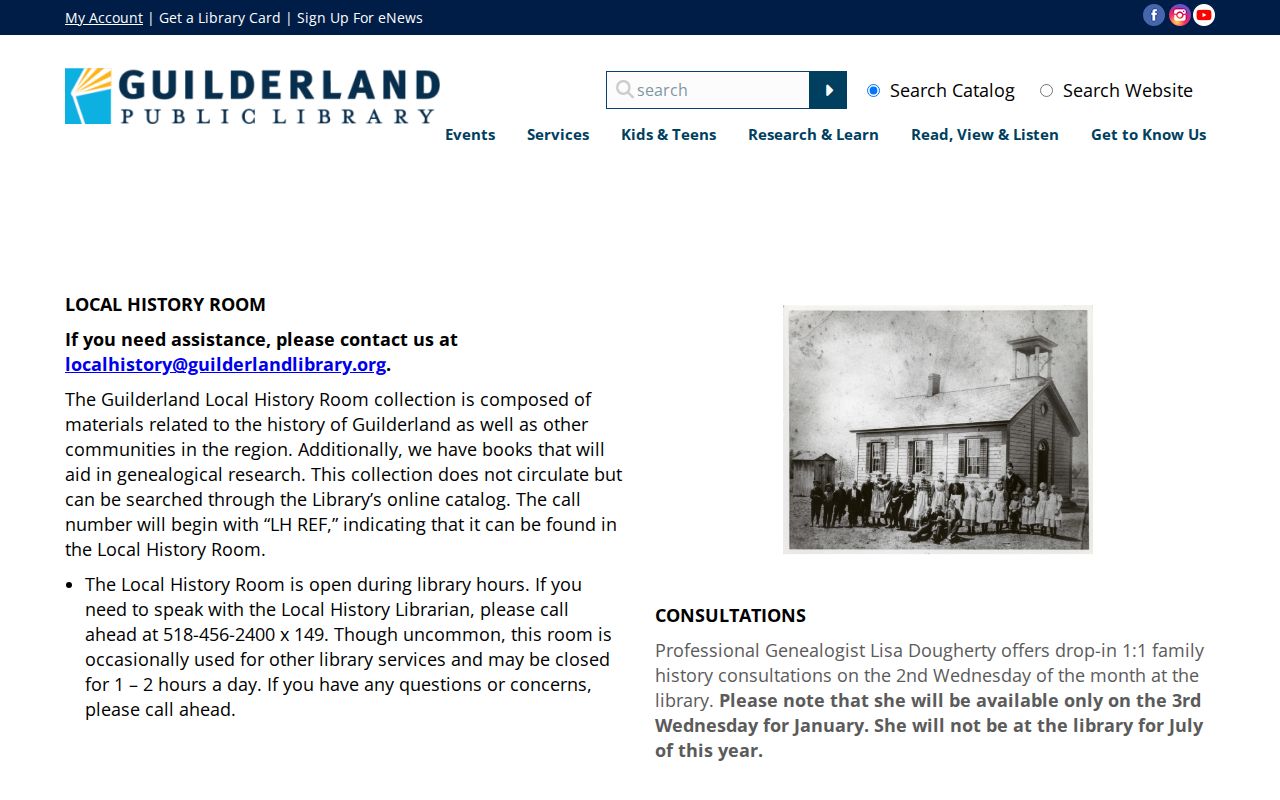
The GPL Local History Room is noncirculating and usually available during library hours, although it can close briefly. Researchers sign in and out, use pencils, and keep material in the room; staff photocopy for a small fee. Contact localhistory@guilderlandlibrary.org or 518-456-2400 x149 for a focused question. Staff can help by phone, mail, or email but do not perform deep research, and replies can take weeks.
The Albany County Hall of Records adds Albany city directories, census records from 1855-1925, public grantor/grantee references, and historical indexes. Mail research is $20 per hour, while onsite copies are 50 cents per page or a written certification costs $4. The Guilderland Historical Society preserves photographs, writings, buildings, monuments, and sites, but no public surname index or posted research fee was located.
Guilderland Directory Evidence
The strongest town-level companion sources are the GPL yearbooks, cemetery material, newspaper holdings, and New York Heritage images. GPL lists Tawasenthan/Guilderland High School yearbooks from 1946 forward, Fairview and Prospect Hill cemetery material, and the Altamont Enterprise in print from 2009 forward. New York State Historic Newspapers carries the Altamont/Knowersville Enterprise historic run from 1884-2008. These are dated historical channels, not a current list of people.
Use the source that answers the narrow question. A directory offers a printed name-and-address association. A cemetery record can test a death or burial lead. A newspaper can add a date or event context. A deed or annual assessment roll follows the parcel. The Guilderland Historical Society's New York Heritage collection can add photographs of farmhouses, barns, and Dutch architecture when a family-history search becomes a place-history search. Keep each citation separate so a plausible story remains traceable to the underlying record.