
Finding Guilderland Resident Records
“Resident” is an everyday term, while each official index records a narrower connection. A parcel roll can identify an owner and a tax location. A directory can show that a publisher associated a household with an address in a particular edition. A court index can show a party name and case context. Treat those as separate findings. That approach matters in Guilderland, where a postal label may differ from the town jurisdiction and an owner mailing address may be somewhere else.
Begin with the question, not the broadest search. A current parcel question starts with the property index. A past household question starts with a directory year, newspaper, cemetery, or census lead. A legal record starts with the correct court system. Each result should retain the source date, the exact spelling returned, and a label such as recorded owner, historical occupant, or possible match.
- Search the address or name in Albany County’s property index and save the parcel number, property location, owner field, and roll year.
- Use the parcel viewer to check the map context, then look for recorded instruments through the County Clerk.
- For a particular person, compare a second independent record such as a directory entry, court index, obituary, or vital-record lead.
- For a historical household, record the directory edition and page before pairing it with a deed, census, newspaper, or cemetery source.
- When the material is not online, ask the proper custodian, library, clerk, or Hall of Records for the specific record series and date range.
Note: A name in one Guilderland source is a lead, not proof that a person currently occupies an address.
Guilderland Resident Record Offices
Three offices anchor most current Guilderland record checks. The County Clerk holds recorded land instruments and some court-record functions. The county’s Real Property Tax Service Agency links the parcel, tax-map, assessment-roll, and GIS tools. The Board of Elections manages election administration and links the state’s individualized voter service. Their records do different jobs, so a name or address should keep its source label. For a road-by-road sequence, use the fuller Guilderland street directory workflow.
Real Property Tax Service
112 State Street, Room 1103
Albany, NY 12207
518-487-5290
Guilderland Resident Parcel Search
Albany County PROS is the main official property index for a Guilderland address or owner name. It can return current and prior-owner paths, deed and map references, assessment data, inventory details, and comparable-sales information. Enter the property location and the owner mailing address as two distinct fields in your notes. The first tells where the taxable parcel sits; the other tells where correspondence goes. Neither field alone states who is presently living there.
| PROS field | How it works |
|---|---|
| Street Address | Optional text, such as a house number and street name without a suffix. |
| Tax Map # / SBL | Optional section-block-lot identifier, often found on a tax bill. |
| Owner Name | Optional current or prior owner search; an equals sign before a surname narrows to an exact last name. |
| Street Finder | Optional public-road dropdown that can return addresses on a selected street. |
| Municipality | Optional Albany County municipality selector, not a ZIP filter. |
The PROS search form is shown below. Pair its result with the county parcel map when a road, border, or nearby parcel matters. The query date matters because assessment and map records are updated over time.
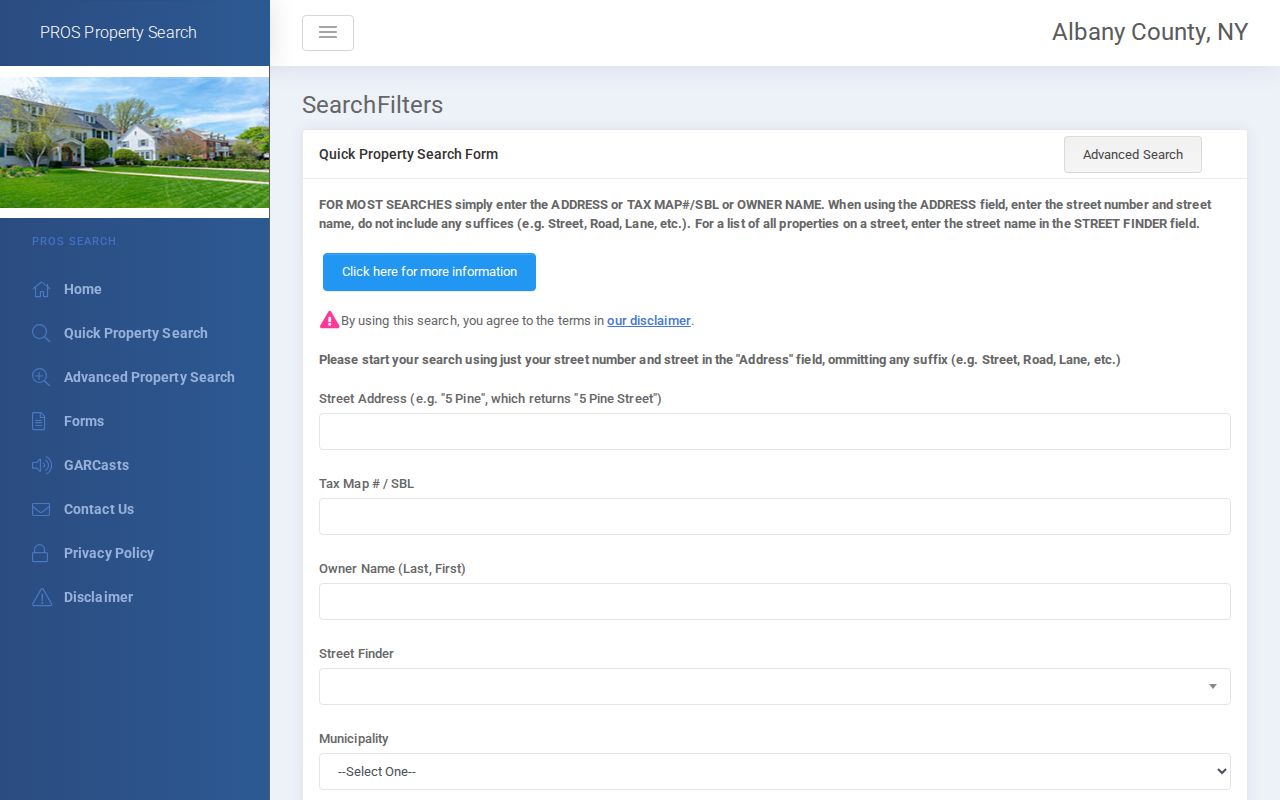
The address, SBL, owner, street-finder, and municipality controls make PROS an address-first research tool. The county’s interactive parcel map adds geometry and adjacent-parcel context, not a legal survey determination.
Guilderland Resident Roll Limits
The state’s voter lookup is an election-service tool, not a public list of everyone in Guilderland. It asks for county, name, date of birth, ZIP or address details, and works for a registered voter’s poll-site, registration, and mail-ballot functions. Election Law limits voter-registration information to election purposes, and confidential registration under Election Law §5-508 can protect an eligible address. A missing result never establishes that a person is absent from a place.
The captured voter screen illustrates why a responsible search begins with the person’s own identifiers rather than a street-wide sweep. Use the result only for its stated election function, then keep it separate from parcel, directory, or court evidence.
New York’s voter service uses an individual verification form rather than a downloadable resident roll.
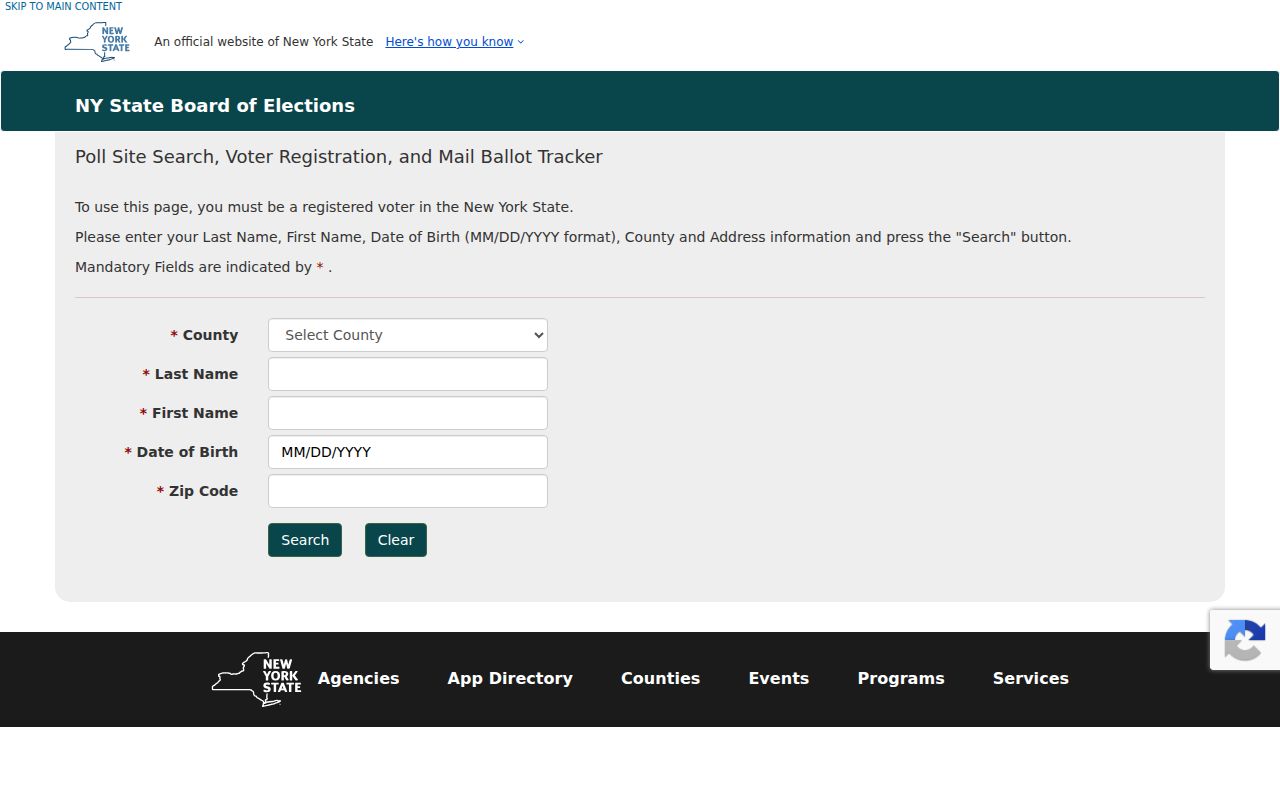
When a person needs to confirm their own registration or polling details, the official form is the correct channel. It should not be used to draw conclusions about a block or household.
Current Guilderland Directory Sources
Guilderland has no single current resident roll. The useful sources are records with different purposes and different access rules. The table separates their strongest use from the conclusion they cannot safely support. This distinction keeps a property owner, a court party, a licensee, and a directory occupant from being treated as the same kind of record.
| Record source | Useful connection | Custodian | Access route |
|---|---|---|---|
| PROS and annual assessment roll | Parcel, owner field, mailing address, assessment context | Albany County Real Property Tax Service | Free public portal and annual local rolls |
| Recorded land index | Grantor, grantee, instrument, recording date, book or document reference | Albany County Clerk | Online images advertised from 1980 forward; earlier requests use office channels |
| Voter service | A registered voter’s own election information | New York State and Albany County elections offices | Individual lookup with identifying information |
| Town records and permits | Public administrative or project context tied to a form or address | Town of Guilderland custodian | Office channel or a properly scoped FOIL request |
| Licensed and entity records | Public professional, entity, or service-address information | New York State agencies | Record-specific state searches |
For all three record categories, the official result is usually more precise about its date and scope than a commercial people-finder category. Official sources identify their custodian, field labels, and restrictions. Commercial summaries may combine old addresses or omit source dates, so they should never replace the underlying roll or instrument.
Note: An administrative request under New York FOIL can seek eligible Town records, but FOIL does not override vital, voter, court, or confidentiality rules.
Guilderland Resident Court Checks
New York eCourts separates WebCivil Local, WebCivil Supreme, WebCriminal, WebFamily, eTrack, and related court functions. WebCivil Local can use index number, party name, attorney or firm, judge, and calendar paths. NYSCEF guest case search adds case identifiers, county, case type, and filing-date controls for e-filed matters. A party name is only an index lead. Record the court, case number, status, and search date before requesting a file from the clerk.
Sealed matters, youthful-offender records, adoptions, Article 81 matters, records not yet entered, and some limited local-civil displays may not appear. The Guilderland Justice Court and the relevant county or court clerk hold the local access route for a file. Staff can explain access logistics but cannot give legal advice.
The official PACER entry point is a separate federal case and document system. Federal results should remain labeled as federal rather than blended into a Town Justice or New York state result.
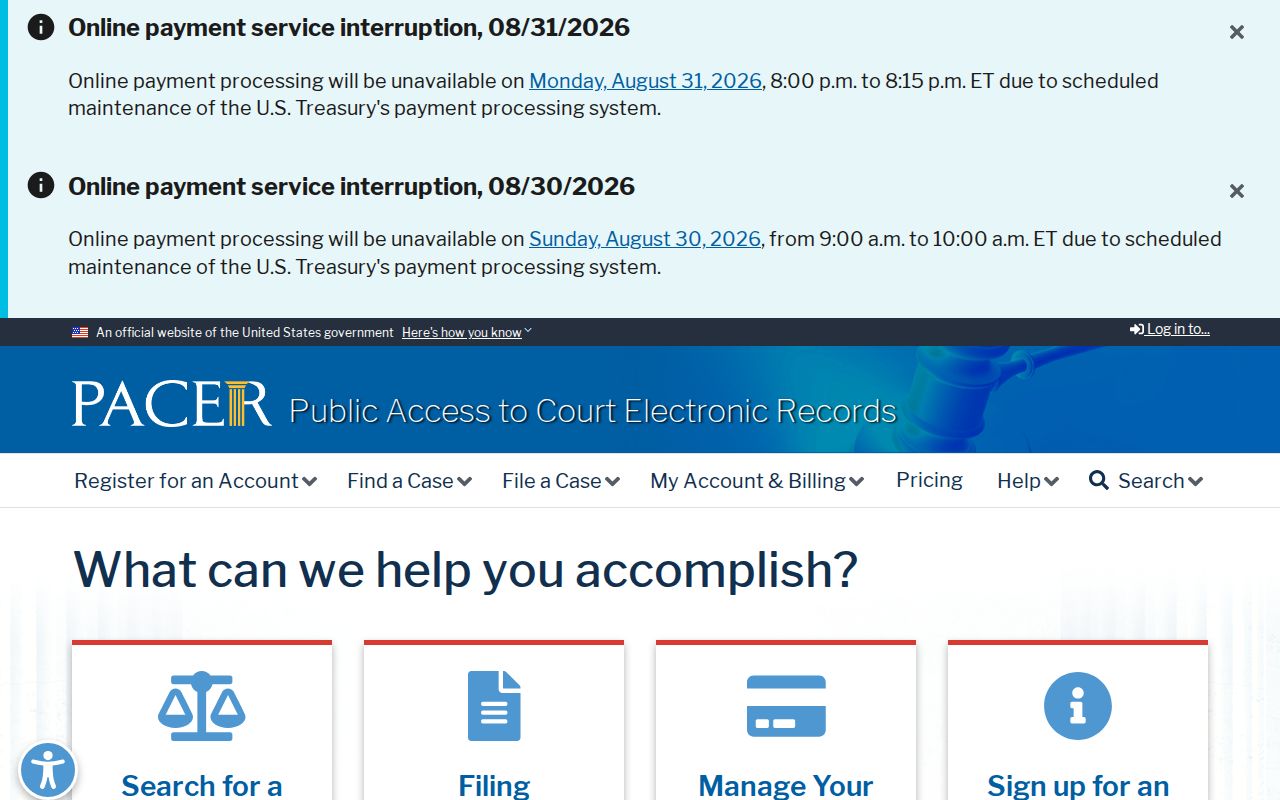
The PACER entry screen is a reminder that court layers are jurisdiction-specific. A court index should be read as a record-access lead, not as a broad personal profile.
Guilderland Resident Event Records
Vital records verify events and relationships, not present occupancy. The Guilderland Registrar is the local route when an eligible death certificate was filed in the town. The research identifies a $10 fee for a certified copy and specifies relationship, ID, and claim requirements. A death is filed where it occurred, which may not be where the person lived.
For older, statewide genealogy work outside New York City, use the New York State Department of Health genealogy channel. The published time periods are 75 years for births when the person is known deceased, 50 years for deaths, and 50 years for marriages when both parties are known deceased. Direct-line descendants may seek a waiver with proof. Those rules are distinct from ordinary public-record access.
- Parcel
- A taxable piece of land identified by a tax-map or SBL number.
- Index
- A searchable list that points to a record; it is not always the record image or certified copy.
- Criss-cross directory
- A reverse directory arranged to connect an address with a listed person or household.
- Certified copy
- A custodian-issued copy that carries the office’s certification, subject to eligibility rules.
Historic Guilderland Resident Directories
Historical names are best read beside the directory’s place coverage. Albany Public Library has an Albany city run beginning in 1813 and some suburban material. Schenectady County Public Library lists a combined Colonie, Bethlehem, and Guilderland run for 1956 through 1978. The Albany County Hall of Records adds Albany city directories from 1830 through 1994, street guides from 1914 forward, census records, and a public grantor-grantee reference. A Guilderland address may need more than one shelf because city, suburb, hamlet, and postal labels do not share the same boundary.
The Guilderland Public Library Local History Room contributes yearbooks, cemetery material, newspapers, and the Gregg Collection. For the full historical-shelf method, use the Guilderland city directories collection page. Record the edition, page, abbreviations such as h or bds, and the publisher’s stated geographic scope before treating an entry as household evidence.
Directory gaps also matter. The APL guide notes no 1836 directory, a missing 1980 volume, and 1982, 1984, and 1987 as years that were reportedly not published. A gap in a directory run is a coverage issue, not proof that a person or address was absent.
Tracing Guilderland Resident Deeds
A deed trail explains a recorded property connection across time. Start with the current PROS result and note the SBL, property location, owner field, and any prior-owner information. Then use the County Clerk’s land index to identify the instrument type, grantor, grantee, recording date, book and page or document number, and legal description. A grantor transfers an interest; a grantee receives it. Those names belong to a conveyance record and should not be recast as a current household list.
County Clerk land-record images are advertised online from 1980 forward. For a pre-1980 deed or mortgage search, the Clerk accepts an in-person or written request, with the research reporting a $5 charge per name for each two-year search period. Mail requests need names, an approximate date, record type, payment, and return postage. The Hall of Records can extend a historical search through its public grantor-grantee reference and physical research materials.
Note: A legal description and SBL are steadier parcel keys than a road name when an older record uses a farm, hamlet, or different postal label.
Guilderland Resident Research Desks
When a portal stops at an index, Guilderland’s local research desks supply the next layer. The Guilderland Public Library Local History Room has the Gregg Collection, yearbooks from 1946 forward, cemetery material, newspapers, and New York Heritage access. Materials are noncirculating, researchers sign in, and staff can answer focused questions but do not undertake open-ended research. The library says responses can take weeks, so a narrowly framed request works best.
Albany Public Library’s Local History Room is available by appointment and has the city-directory guide, local-history books, microfilm, and regional holdings. Albany County Hall of Records offers directories, census records, naturalization references, historical grantor-grantee material, and mail research. The State Archives becomes useful when the record is state-created and a local shelf or online index ends. Preserve the collection title, edition, page, and access date in every research note.
Guilderland Resident ZIP Checks
Postal labels help expand a search but do not decide municipal jurisdiction. Official local materials reference Guilderland, Guilderland Center, Altamont, Slingerlands, Voorheesville, Albany, and Schenectady labels around the town. A parcel may be in Guilderland even when its mailing address uses Albany or Schenectady. For a delivery question, use the USPS ZIP lookup with the complete address. Then use PROS and the county map for the tax municipality and parcel context.
ZIP+4 refines delivery routing. It does not establish ownership, polling district, school district, or a municipal boundary. The Town planning map, county parcel GIS, and USPS answer different parts of the same address question.
Guilderland Resident Privacy Limits
New York records have real privacy boundaries. The Address Confidentiality Program can provide a substitute address for eligible participants, while confidential voter registration is a separate protection route. Court, vital, election, custody, and vehicle-related data each have their own statutory rules. A no-result, redaction, or protected address should be reported as an access limit, not used to speculate about a person’s location.
New York FOIL, Public Officers Law Article 6, is the administrative-record route when an agency has a disclosable record. A request should name the office, record type, date range, and desired format. The law does not convert a protected record into an open one.
Protecting Guilderland Record Searches
The Town’s 2026 impersonation-phishing alert warned about fake payment messages that imitate Town services, including building and zoning requests. Urgent language, altered web addresses, senders with extra characters, and unfamiliar phone numbers are warning signs. Type the official Town address yourself or call through the published Town number before sharing payment or record information.
The official alert below provides a local reminder to verify the custodian before paying for a record or responding to a message. Albany County also offers a property-fraud alert service for deed or mortgage recordings under a subscriber’s name; it is a notification tool, not a replacement for reviewing a deed with the Clerk.
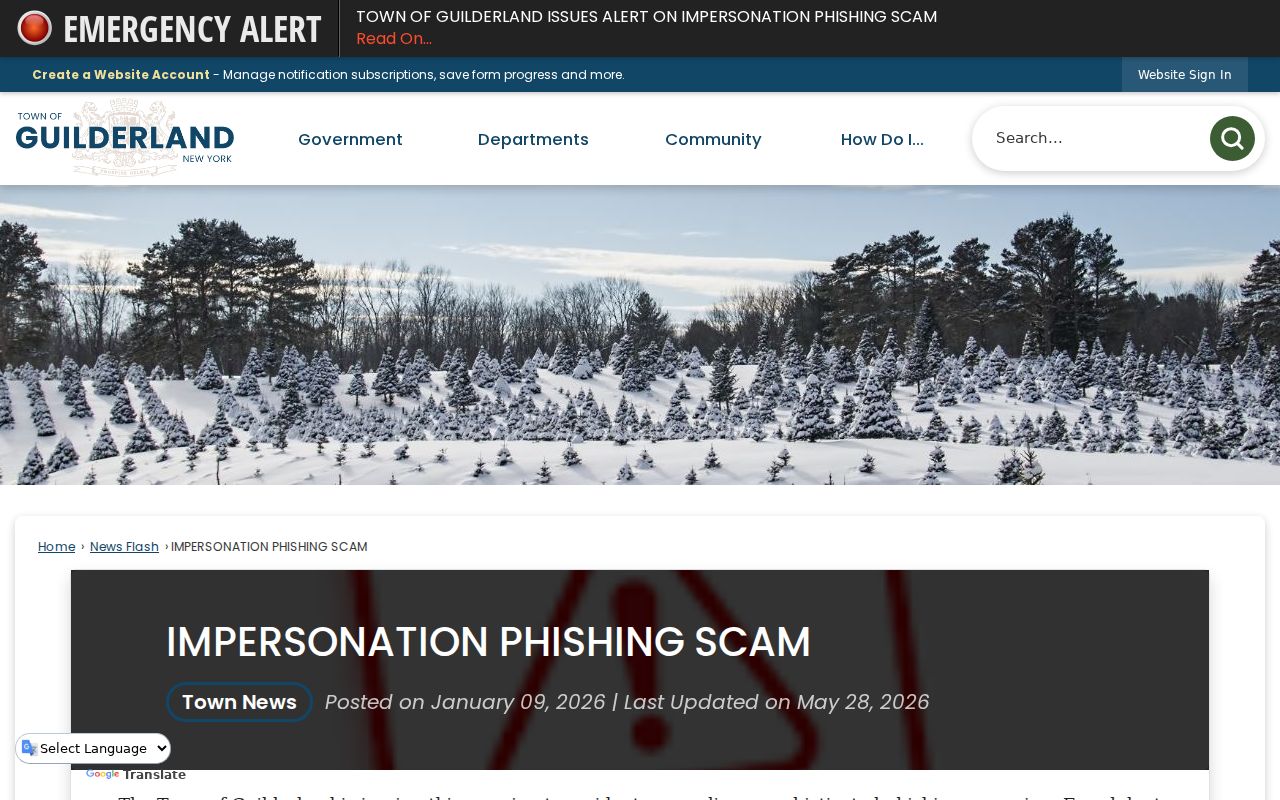
For a suspected local payment scam, the Town directs residents to report it through Guilderland Police or the New York Attorney General’s consumer-fraud channel. Verify every record and fee with the office that holds it.